Mirrors are key elements in any successful environment!... They are not only wonderful ways of visually doubling a space, but depending on the mirror, could be gorgeous pieces of jewelry for your space... Here are some of my favorite mirrors...
One of the mirrors I've loved for years comes from BDDW, a showroom dripping in chic! I love this place, and even after so many knock offs and repros the original still makes me happy... This is the Captain's Mirror!
Next from a smaller product company Grain, this is the simple Hitch Mirror... So simple a concept, an great shaped mirror, hole cut in it to accommodate a thick piece of Manila rope... Gorgeous!
Holly Hunt is a major player in the design world, and always will be, and they have got an amazing set of Convex Mirrors perfect for an entry foyer, a dining room, a bedroom, and master suite... Okay pretty much anywhere...
Shown in the Dennis Miller showroom is Espacio by Sami Hayek, who pay tribute to the artisans of the Huichol people of Western Mexico. This is the Mestizo Mirror created by laying individual beads creating authentic Huichol patterns.
Lastly from my buddy Bobby Berk's shop Bobby Berk Home is the Frame of Love Pink Intimacy, which is just good ole fashioned fun! This will give any room and instant smile! The color alone is making me happy!
My world is all about being creative, and assisting those in making beautiful ideas and visions come to life. I wanted to show what inspires me, and share some great thoughts, tips and other wonderfully beautiful things that keep my imagination and innovation going... Where do you find your inspiration?
Wednesday, June 27, 2012
Tuesday, June 19, 2012
Faux Bois
Let's learn a little designer term... Faux Bois (from the French for false wood) refers to the artistic imitation of wood or wood grains in various media. It's something that's been around forever, but maybe you weren't sure of what it was, or how prevalent it is...
I think using a Faux Bois piece is a great way to add texture or visual interest without really using wood, if the space doesn't call for it... Here are a few of some of the wonderful applications that this "False Wood" can be used...
![]() | |
| A Wood Grain rug is a simple way to bring a fun textural element to any space! |
![]() |
| This cast wood stump bring the organic into any static space that needs Mother Nature's loveliness... |
![]() |
| Robert Kuo is a master of materials, here his lacquer and copper work meld into the perfect cube! |
![]() |
| Designer Kelly Wearstler's updated graphic Faux Bois fabric line! So chic! |
![]() |
| GUS Modern's transparent way of bringing in wood grain on this clear plexi side table is so smart! |
Thursday, June 14, 2012
Kilims...
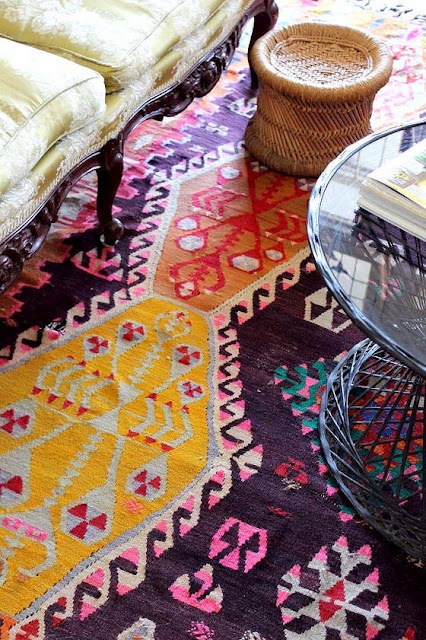
What's a Kilim? You've probably seen them before and completely loved what you saw, but what did you see? Something like this?
Kilims are flat tapestry-woven carpets or rugs produced from the Balkans to Pakistan. Kilims can be purely decorative or can function as prayer rugs. Recently-made kilims are popular floor-coverings in Western households. *Wikipedia definition
They are abundant and easy to find in a myriad of colors and patterns! They have been used to re-upholster chairs, and made into cushions... Their appeal is far reaching and there is something for everyone!
Kilims are produced by tightly interweaving the warp and weft strands of the weave to produce a flat surface with no pile. Most kilim weaves are "weft-facing", i.e., the horizontal weft strands are pulled tightly downward so that they hide the vertical warp strands.
When the end of a color boundary is reached, the weft yarn is wound back from the boundary point. Thus, if the boundary of a field is a straight vertical line, a vertical slit forms between the two different color areas where they meet. For this reason, most kilims can be classed as "slit woven" textiles. The slits are beloved by collectors, as they produce very sharp-etched designs, emphasizing the geometry of the weave. Weaving strategies for avoiding slit formation, such as interlocking, produce a more blurred design image.
The weft strands, which carry the visible design and color, are almost always wool, whereas the hidden warp strands can be either wool or cotton. The warp strands are only visible at the ends, where they emerge as the fringe. This fringe is usually tied in bunches, to ensure against loosening or unraveling of the weave. [Source for this description of the weaving: Davies 2000]. *Wikipedia definition
Using a Kilim, especially in a very contemporary space is the perfect way to balance out the sleek lines of the modern aesthetic with punchy colors or patterns! I think too, the most successful spaces are a blended mix of new and old, color and starkness...
I think it's one of the simplest way to give a vanilla room an instant update! The nearly infinite color palate is going to appease even the most finicky of clientele (mostly your significant other)... Hehehe!
The wonderful thing too now is because of their popularity, you don't need to spend thousands for the look... Many big box retailers are offering new versions for just a few hundred dollars to satisfy anyone's budget and our need for a super sexy accent everyone will die over!
**Images all from Pinterest
Kilims are flat tapestry-woven carpets or rugs produced from the Balkans to Pakistan. Kilims can be purely decorative or can function as prayer rugs. Recently-made kilims are popular floor-coverings in Western households. *Wikipedia definition
They are abundant and easy to find in a myriad of colors and patterns! They have been used to re-upholster chairs, and made into cushions... Their appeal is far reaching and there is something for everyone!
Kilims are produced by tightly interweaving the warp and weft strands of the weave to produce a flat surface with no pile. Most kilim weaves are "weft-facing", i.e., the horizontal weft strands are pulled tightly downward so that they hide the vertical warp strands.
When the end of a color boundary is reached, the weft yarn is wound back from the boundary point. Thus, if the boundary of a field is a straight vertical line, a vertical slit forms between the two different color areas where they meet. For this reason, most kilims can be classed as "slit woven" textiles. The slits are beloved by collectors, as they produce very sharp-etched designs, emphasizing the geometry of the weave. Weaving strategies for avoiding slit formation, such as interlocking, produce a more blurred design image.
The weft strands, which carry the visible design and color, are almost always wool, whereas the hidden warp strands can be either wool or cotton. The warp strands are only visible at the ends, where they emerge as the fringe. This fringe is usually tied in bunches, to ensure against loosening or unraveling of the weave. [Source for this description of the weaving: Davies 2000]. *Wikipedia definition
Using a Kilim, especially in a very contemporary space is the perfect way to balance out the sleek lines of the modern aesthetic with punchy colors or patterns! I think too, the most successful spaces are a blended mix of new and old, color and starkness...
I think it's one of the simplest way to give a vanilla room an instant update! The nearly infinite color palate is going to appease even the most finicky of clientele (mostly your significant other)... Hehehe!
The wonderful thing too now is because of their popularity, you don't need to spend thousands for the look... Many big box retailers are offering new versions for just a few hundred dollars to satisfy anyone's budget and our need for a super sexy accent everyone will die over!
**Images all from Pinterest
Subscribe to:
Posts (Atom)